

September sits between Morocco’s hottest month and its more temperate autumn season, which is exactly why it attracts so many travelers. When choosing the best places to visit in Morocco in September, the right answer depends on the region and which part of the month you visit.
Marrakech and Morocco’s interior regions can remain hot, especially during early September, while Essaouira and the Atlantic coast are generally milder. The High Atlas Mountains offer comfortable hiking conditions as summer heat begins to ease, and the Sahara Desert near Merzouga becomes increasingly suitable for outdoor experiences later in the month.
This guide explains where to go, what weather to expect, how long to stay, and how to create a realistic Morocco itinerary for September.
Is September a Good Time to Visit Morocco?
Yes, September is generally a good time to visit Morocco, particularly for travelers who want to avoid the strongest summer heat and the busiest holiday crowds.
Early September may still feel like summer in Marrakech, Fes, Ouarzazate, and the Sahara Desert. By the second half of the month, temperatures often become more comfortable, especially during mornings and evenings.
Atlantic destinations such as Essaouira remain mild and breezy throughout much of the month. The High Atlas Mountains also become increasingly attractive for hiking, village visits, and outdoor activities.
Travelers who are sensitive to heat should consider visiting during the second half of September or combining inland destinations with the coast and mountains.
September at a Glance
| Destination | Typical September Conditions | Best For | Important Consideration |
|---|---|---|---|
| Marrakech | Hot early in the month, becoming more comfortable later | Culture, food, souks and day trips | Avoid long walks during the hottest midday hours |
| Merzouga & Erg Chebbi | Hot days with cooler evenings and nights | Camel trekking, desert camps and photography | Schedule dune activities around sunrise and sunset |
| High Atlas Mountains | Mild days and cooler nights | Trekking, villages and mountain scenery | Temperatures can change quickly at altitude |
| Essaouira | Mild, coastal and breezy | Relaxation, seafood and coastal walks | Bring a light layer for windy evenings |
| Ouarzazate & Aït Benhaddou | Warm and generally dry | Kasbahs, history and photography | There is limited shade at some sites |
| Dades Valley & Todra Gorge | Warm days and cooler nights | Road trips, canyon walks and landscapes | Travel distances are longer than they appear |
| Fes | Warm, with cooler conditions later in the month | Medina history, crafts and architecture | The Medina can be tiring during hot afternoons |
| Chefchaouen | Mild to warm | Photography, walking and a relaxed stay | It fits northern itineraries better than southern routes |
| Agafay Desert | Warm days and pleasant evenings | Short desert experiences near Marrakech | Agafay is rocky, not a sand-dune desert |
These conditions describe typical September patterns rather than a guaranteed daily forecast. Actual temperatures and weather can vary.
Morocco Weather in September: What to Expect
Morocco’s September weather varies considerably by region. Inland cities can remain hot, the Atlantic coast is generally milder, the mountains are cooler, and the Sahara experiences significant differences between daytime and nighttime temperatures.
Early September Versus Late September
The first half of September often carries the heat of summer, particularly in Marrakech, Fes, Ouarzazate, and the desert regions. Visitors should plan long walks and outdoor sightseeing for the morning or late afternoon.
During the second half of the month, conditions usually become more comfortable. Evenings feel cooler, outdoor dining becomes more enjoyable, and desert and mountain experiences become easier to manage.
Inland Cities
Marrakech and Fes can still experience hot daytime conditions. The narrow streets of the Medinas provide some shade, but they may also retain heat. Plan museums, riad breaks, hammams, or indoor attractions around midday.
Atlantic Coast
Essaouira and other Atlantic destinations are typically cooler than inland Morocco because of coastal breezes. Evenings may feel cool enough for a light jacket, especially near the sea.
Sahara Desert
September days in the Sahara remain hot, but mornings, evenings, and nights are more comfortable than during midsummer. Camel treks, sandboarding, and dune excursions should be planned around sunrise or sunset rather than midday.
High Atlas Mountains
September is an attractive month for trekking in the High Atlas Mountains. Daytime conditions can be comfortable, but temperatures drop quickly at higher elevations. Travelers should carry layers and check current mountain conditions before departure.
Travel tip: Climate averages can help with planning, but they are not a forecast. Check updated local conditions shortly before departure.
1. Marrakech: Culture, Food and Late-Summer Energy
Marrakech remains one of the best places to visit in Morocco in September, especially for travelers who organize their days around the warmer hours.
Early mornings are suitable for exploring the Medina, visiting palaces, and walking through the souks. During midday, visitors can enjoy a riad courtyard, museum, traditional hammam, or shaded restaurant. Jemaa el-Fna becomes particularly lively as temperatures begin to fall in the evening.
Best Things to Do in Marrakech
- Explore the Medina and traditional souks
- Visit Bahia Palace
- Walk through Majorelle Garden
- Experience Jemaa el-Fna in the evening
- Join a Marrakech food tour
- Relax with a traditional hammam and Moroccan massage
Recommended stay: Two to three nights.
Best for: First-time travelers, couples, food lovers, culture-focused visitors and travelers using Marrakech as a base.
Potential disadvantage: Early September afternoons can remain uncomfortable for long periods of walking.
Local tip: Explore the Medina before midday or after 5 p.m. and use the hottest hours for indoor or shaded experiences.
Marrakech connects naturally with the Agafay Desert, the Ourika Valley, Essaouira, Aït Benhaddou and longer Sahara routes. You can also explore all tours departing from Marrakech.
2. Merzouga and Erg Chebbi: Sahara Desert Nights
Merzouga is a small settlement beside the Erg Chebbi dunes in southeastern Morocco and one of the country’s most popular gateways to the Sahara Desert.
September is a transitional month in the desert. Daytime temperatures can remain high, but evenings become increasingly comfortable. This makes sunrise, sunset and overnight camp experiences more enjoyable than during the hottest summer weeks.
Best Things to Do in Merzouga
- Camel trekking across Erg Chebbi
- Stay overnight in a desert camp
- Take a 4x4 desert excursion
- Try sandboarding
- Watch sunset over the dunes
- Enjoy stargazing away from city lights
Recommended stay: At least one night, although two nights allow for a less rushed experience.
Best for: Adventure travelers, photographers, couples and travelers completing a southern Morocco circuit.
Potential disadvantage: Merzouga requires a long journey from Marrakech or Fes. The route is more enjoyable when divided into stages.
Local tip: Plan camel rides and dune walks during the first hours of the morning or in the two hours before sunset.
Travelers departing from Marrakech can compare the 2-day Merzouga desert tour, the 3-day Marrakech desert tour to Merzouga, and the 4-day desert tour from Marrakech to Merzouga.
3. High Atlas Mountains: September Trekking and Village Experiences
The High Atlas Mountains offer a cooler alternative to Morocco’s inland cities and desert regions. September is often a suitable period for hiking because the strongest summer heat begins to ease.
Imlil is a popular base for mountain walks, Berber village experiences and routes toward Jbel Toubkal. The region is also suitable for travelers who want to combine nature with local culture without spending several days in the desert.
Best Things to Do in the High Atlas Mountains
- Take a guided day hike from Imlil
- Visit traditional mountain villages
- Explore the Ourika Valley
- Join a multi-day trekking route
- Photograph mountain landscapes and valleys
Recommended stay: One day for a valley excursion or two to four days for trekking.
Best for: Hikers, nature lovers, photographers and travelers seeking cooler outdoor conditions.
Potential disadvantage: Mountain weather can change quickly, particularly at higher elevations.
Local tip: Bring multiple layers even when Marrakech feels hot. Mountain temperatures can fall quickly after sunset.
Travelers can choose an Ourika Valley day trip from Marrakech, a 2-day Toubkal trekking route, a 3-day Berber villages trek, or a 3-day Toubkal summit trek.
4. Essaouira: A Cooler Atlantic Escape
Essaouira is one of Morocco’s most reliable September destinations for travelers who prefer cooler conditions. Located on the Atlantic coast west of Marrakech, the city is known for its fortified Medina, working fishing port, seafood and coastal atmosphere.
The sea breeze keeps temperatures milder than in Marrakech and the interior. This makes Essaouira a useful addition to a September itinerary, particularly after several warm days inland.
Best Things to Do in Essaouira
- Walk through the UNESCO-listed Medina
- Visit the fishing port
- Explore the city ramparts
- Try fresh seafood
- Walk along the beach
- Watch sunset from the coast
Recommended stay: One to two nights, or a full day from Marrakech.
Best for: Heat-sensitive travelers, couples, photographers and visitors looking for a slower pace.
Potential disadvantage: Coastal wind may make the beach feel cooler than expected.
Local tip: Carry a light jacket or overshirt for the late afternoon and evening.
Essaouira can be visited on a Marrakech to Essaouira day trip or as part of a 2-day Marrakech tour to Essaouira.
5. Ouarzazate and Aït Benhaddou: Kasbahs and Film Landscapes
Ouarzazate and nearby Aït Benhaddou form an important stop between Marrakech and the Sahara Desert. Aït Benhaddou is a historic fortified settlement near Ouarzazate and a UNESCO World Heritage Site.
September’s warm and generally dry conditions are suitable for visiting the earthen buildings, kasbahs and film locations of southern Morocco. However, there is limited shade, so early morning visits are usually more comfortable.
Best Things to Do
- Walk through Aït Benhaddou
- Visit Taourirt Kasbah
- Explore film studios near Ouarzazate
- Photograph the landscape during golden hour
- Continue toward Dades Valley and Merzouga
Recommended stay: Half a day for Aït Benhaddou or one night in Ouarzazate when continuing toward the desert.
Best for: Photographers, history enthusiasts and travelers following the southern kasbah route.
Potential disadvantage: The main sites offer little protection from the midday sun.
Local tip: Visit Aït Benhaddou early to avoid both heat and the busiest group-tour hours.
Options include the Marrakech to Aït Benhaddou day trip, the 2-day Ouarzazate to Merzouga route, or other tours departing from Ouarzazate.
6. Dades Valley and Todra Gorge: Canyon Country
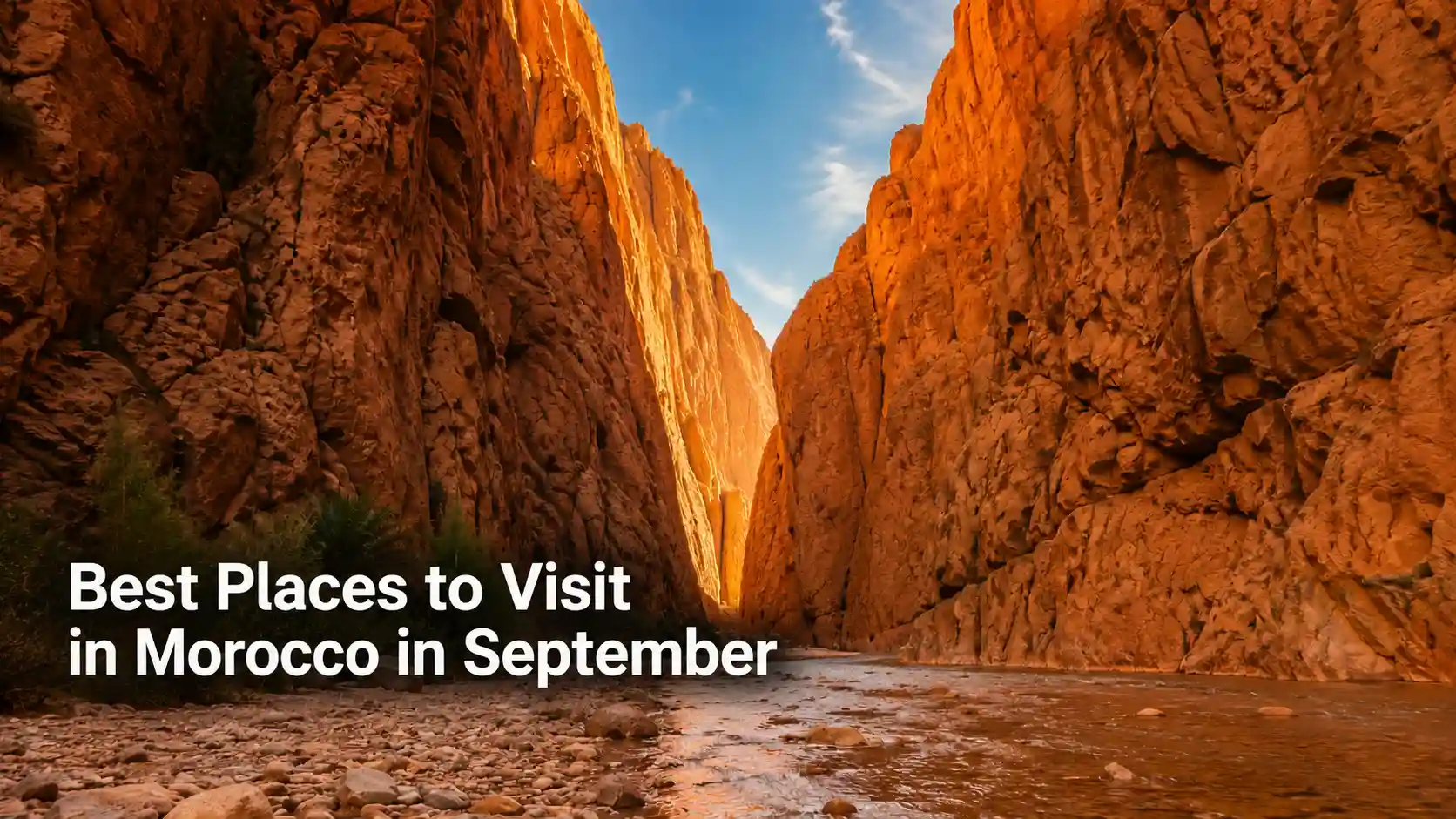
The Dades Valley and Todra Gorge are located along the southeastern side of the Atlas Mountains. The region is known for dramatic roads, rock formations, palm-filled valleys and towering canyon walls.
September is suitable for scenic drives and shorter walks because conditions are generally dry and gradually become cooler toward the end of the month.
Best Things to Do
- Drive through the Dades Valley
- Photograph the famous winding road
- Walk through Todra Gorge
- Visit nearby villages and palm groves
- Stop overnight between Ouarzazate and Merzouga
Recommended stay: One night as part of a southern Morocco itinerary.
Best for: Road-trip travelers, photographers, hikers and visitors continuing toward the Sahara.
Potential disadvantage: The region involves substantial driving, and scenic stops are spread over a wide area.
Local tip: Visit Todra Gorge in the morning or late afternoon, when conditions are cooler and the canyon light is more attractive.
The Dades and Todra region is commonly included in multi-day desert tours such as the 3-day Sahara Desert tour from Marrakech.
7. Fes: Medina History and Traditional Crafts
Fes is one of Morocco’s most culturally significant cities and is known for its historic Medina, religious architecture, traditional workshops and tanneries.
The city remains warm in September, particularly early in the month. However, the covered passages and shaded sections of Fes el-Bali can make exploration more manageable than open-air sightseeing during the hottest hours.
Best Things to Do in Fes
- Explore Fes el-Bali
- Visit traditional craft workshops
- See the tanneries from a viewpoint
- Discover historic madrasas
- Join a guided Medina experience
Recommended stay: Two nights.
Best for: History lovers, cultural travelers, architecture enthusiasts and visitors interested in traditional crafts.
Potential disadvantage: The Medina is complex and can be difficult to navigate independently.
Local tip: Book a local guide for your first visit to the Medina to understand its history and avoid losing time.
Explore Fes on a guided Medina tour, then continue toward the Sahara on a 3-day Fes to Merzouga desert tour. You can also browse all tours departing from Fes.
8. Chefchaouen: The Blue City in the Rif Mountains
Chefchaouen is located in northern Morocco within the Rif Mountains. The city is known for its blue-painted streets, mountain setting and relaxed atmosphere.
September is a pleasant time to explore Chefchaouen, particularly during the second half of the month. Mornings are ideal for photography before the narrow streets become busier.
Best Things to Do in Chefchaouen
- Walk through the blue Medina
- Visit the Spanish Mosque viewpoint
- Explore local cafés and shops
- Take photographs during the early morning
- Visit nearby mountain areas
Recommended stay: One to two nights.
Best for: Photographers, couples, relaxed travelers and visitors following a northern Morocco itinerary.
Potential disadvantage: Chefchaouen is far from Marrakech and southern Morocco, so it should not be added casually to a short desert itinerary.
Local tip: Visit the Medina shortly after sunrise for softer light and quieter streets.
Chefchaouen combines naturally with Fes through the 2-day Fes to Chefchaouen route or the Fes to Chefchaouen day trip.
9. Agafay Desert: A Short Desert Escape Near Marrakech
The Agafay Desert is a rocky landscape located near Marrakech. It offers desert-style scenery and camps without requiring the long drive to Merzouga.
September afternoons can still be warm, but evenings are often suitable for sunset experiences, outdoor dinners and overnight camp stays.
Best Things to Do in Agafay
- Take a sunset camel ride
- Try quad biking
- Have dinner at a desert camp
- Stay overnight under the stars
- Take a hot-air balloon flight near Marrakech
Recommended stay: Half a day or one night.
Best for: Travelers with limited time, families and visitors who want a short experience outside Marrakech.
Potential disadvantage: Agafay does not contain the large sand dunes associated with Erg Chebbi.
Local tip: Arrive in the late afternoon so you can experience sunset and cooler evening temperatures.
Choose the Agafay Desert luxury camp experience or the Agafay Desert tour from Marrakech.
10. Casablanca and Rabat: A Practical Coastal Addition
Casablanca is Morocco’s largest city and a common international arrival point. Although many travelers use it primarily for transportation, it can be combined with Rabat for a short coastal addition.
September conditions are usually milder than in inland cities, with Atlantic air helping to moderate daytime heat.
Best Things to Do
- Visit the area around Hassan II Mosque
- Walk along Casablanca’s Corniche
- Explore Rabat’s historic sites
- Use Casablanca as the starting point for a longer Morocco tour
Recommended stay: One night or one full day.
Best for: Travelers arriving through Casablanca and visitors who want a convenient coastal introduction.
Potential disadvantage: Casablanca is a modern business city and may feel less atmospheric than Marrakech, Fes or Chefchaouen.
Consider a Casablanca to Rabat day trip, a Casablanca to Marrakech trip, or browse all tours departing from Casablanca.
Suggested Morocco Itineraries for September
A realistic itinerary should account for Morocco’s long driving distances. Trying to combine the north, desert, coast and mountains in a few days usually creates more time in the vehicle than at the destinations.
5-Day Morocco Itinerary
- Day 1: Arrive in Marrakech and explore Jemaa el-Fna in the evening.
- Day 2: Visit Marrakech’s Medina, palaces and gardens.
- Day 3: Take an Ourika Valley day trip or visit the Atlas Mountains.
- Day 4: Take an Essaouira day trip or spend the evening in Agafay.
- Day 5: Departure from Marrakech.
This itinerary is best for travelers who want variety without completing long desert transfers.
7-Day Morocco Itinerary
- Day 1: Arrive in Marrakech.
- Day 2: Explore Marrakech’s Medina and main attractions.
- Day 3: Cross the High Atlas Mountains and visit Aït Benhaddou before staying near Ouarzazate.
- Day 4: Continue through Dades Valley and Todra Gorge toward Merzouga.
- Day 5: Explore the Sahara and stay overnight in a desert camp.
- Day 6: Begin the return journey or continue toward Fes.
- Day 7: Departure.
This route includes several long driving days. Travelers who want a slower journey should add one or two extra nights.
A related bookable option is the 7 Days Sahara and Imperial Cities tour.
10-Day Morocco Itinerary
- Days 1–2: Marrakech.
- Day 3: Ourika Valley, Imlil or another High Atlas experience.
- Day 4: Aït Benhaddou and Ouarzazate.
- Day 5: Dades Valley and Todra Gorge.
- Day 6: Merzouga and an overnight Sahara camp.
- Day 7: Begin returning toward Marrakech or continue to Fes.
- Days 8–9: Essaouira.
- Day 10: Return to Marrakech and depart.
This itinerary balances city culture, mountain landscapes, the Sahara and the Atlantic coast. It is particularly suitable for first-time visitors who want to experience several regions without adding northern Morocco.
A similar route is available through the 5-day Toubkal and Merzouga tour, which can be extended with additional Marrakech or Essaouira nights.
14-Day Morocco Itinerary
Travelers with two weeks can combine the southern circuit with Fes and Chefchaouen. This requires careful routing because the distance between southern Morocco and the north is substantial.
A longer route may include Casablanca, Rabat, Chefchaouen, Fes, Merzouga, Todra Gorge, Dades Valley, Ouarzazate, Marrakech, the High Atlas Mountains and Essaouira.
See the 14 Days Grand Morocco Tour for a complete multi-region option.
What to Pack for Morocco in September
- Lightweight clothing: Choose breathable fabrics suitable for warm daytime conditions.
- Modest clothing: Clothing covering the shoulders and knees is practical in Medinas, villages and religious settings.
- Comfortable walking shoes: Medina streets, mountain trails and desert surfaces can be uneven.
- Sun protection: Bring sunscreen, sunglasses and a wide-brimmed hat.
- Reusable water bottle: Regular hydration remains important in September.
- Light evening layer: Coastal areas, desert camps and mountain regions can feel cool after sunset.
- Mountain layers: Bring warmer clothing when hiking at higher elevations.
- Swimwear: Useful for hotel or riad pools and coastal stays.
- Small day bag: Carry water, sunscreen, documents and essential personal items.
- Medication: Keep prescription medication in its original packaging.
Practical Tips for Visiting Morocco in September
Book Popular Accommodation in Advance
September is less crowded than the main summer holiday period, but well-reviewed riads and desert camps can still fill quickly. Reserve important accommodation before arrival, particularly when your itinerary has fixed dates.
Plan Outdoor Activities Around the Heat
Schedule Medina walks, desert activities and kasbah visits for the morning or late afternoon. Use midday for lunch, museums, hammams, shaded gardens or rest.
Do Not Underestimate Driving Distances
Marrakech to Merzouga is a substantial journey. The trip is more comfortable when divided with overnight stops around Ouarzazate, Dades Valley or Todra Gorge.
Carry Cash and a Payment Card
Cards are accepted in many hotels and established restaurants, but cash remains useful in souks, small shops, villages and some rural locations.
Respect Local Photography Preferences
Ask permission before photographing individuals, artisans or people working in markets. Some people may prefer not to be photographed.
Check Current Conditions
Weather, road conditions, hiking routes and event dates can change. Confirm important details shortly before traveling.
Avoid an Overloaded Itinerary
Leaving time for rest, spontaneous stops and slower experiences usually produces a better trip than attempting to visit every famous destination in a few days.
Who Should Visit Morocco in September?
- Couples: September offers pleasant evenings, desert camps and a good balance of activities.
- Families: Coastal stays and Marrakech-based excursions work well, although long desert journeys may be tiring for young children.
- Solo travelers: September is suitable for solo travel, particularly with guided activities and planned transportation.
- Photographers: Desert, mountain and kasbah landscapes offer attractive morning and evening light.
- Adventure travelers: The High Atlas Mountains become more comfortable for trekking as summer heat eases.
- Luxury travelers: Private drivers, riads and desert camps make it easier to combine distant regions.
- Older travelers: A slower itinerary and late-September travel may provide more comfortable conditions.
- Heat-sensitive travelers: Prioritize Essaouira, the mountains and the second half of the month.
Pros and Cons of Visiting Morocco in September
| Advantages | Disadvantages |
|---|---|
| Fewer peak-summer crowds | Early September can remain very hot inland |
| Increasingly comfortable evenings | Desert activities still require careful timing |
| Good High Atlas trekking conditions | Mountain weather can change quickly |
| Mild conditions on the Atlantic coast | Coastal wind may feel cool |
| Strong photography opportunities | Long distances require realistic planning |
| Suitable for combining cities, mountains, desert and coast | Weather differs considerably between regions |
Frequently Asked Questions
Is September a good month to visit Morocco?
Yes. September is generally a good month to visit Morocco, especially for travelers who want to avoid peak summer crowds. Early September can still be hot inland and in the desert, while late September usually offers more comfortable conditions across many regions.
Is Morocco still hot in September?
Yes, particularly during the first half of the month. Marrakech, Fes, Ouarzazate and the Sahara may remain hot during the day. Coastal and mountain destinations are usually more comfortable.
Is Marrakech too hot in September?
Marrakech can be hot during early-September afternoons, but mornings and evenings are more suitable for sightseeing. Conditions often become more comfortable toward the end of the month.
Can you visit the Sahara Desert in September?
Yes. September is suitable for visiting Merzouga and Erg Chebbi, but daytime heat still requires planning. Camel treks and dune activities are best scheduled around sunrise and sunset.
What should I wear in Morocco in September?
Wear lightweight, breathable clothing during the day and carry a light layer for the evening. Travelers visiting the mountains or staying overnight in the desert should bring warmer layers.
Is September crowded in Morocco?
September is generally less crowded than July and August, but it is not completely quiet. Popular riads, desert camps and highly rated tours may still need advance reservations.
Can you swim in Morocco in September?
Yes. Swimming is possible along the Atlantic coast and in hotel or riad pools. Atlantic water may feel cool, especially near Essaouira.
Is September good for hiking in the Atlas Mountains?
Yes. September is often a suitable month for High Atlas trekking because summer temperatures begin to ease. Conditions can change quickly at altitude, so check the forecast and use a local guide for demanding routes.
How many days should I spend in Morocco?
Seven to ten days provides enough time to combine Marrakech with the kasbah route and Sahara Desert. Five days works well for a Marrakech-based trip, while approximately two weeks allows time for northern destinations such as Fes and Chefchaouen.
What is the best Morocco itinerary for September?
A seven-to-ten-day itinerary combining Marrakech, Aït Benhaddou, Dades Valley, Todra Gorge and Merzouga is a strong option. Adding Essaouira creates a cooler coastal contrast after the inland and desert regions.
Does it rain in Morocco in September?
Rain is possible but is usually limited in many popular destinations. Conditions differ by region, and mountain or desert weather can occasionally change unexpectedly.
Should I book a private Morocco tour in advance?
Booking in advance is recommended for popular desert camps, well-reviewed riads and fixed travel dates. A private tour can also simplify the long transfers between Marrakech, Ouarzazate, the Dades Valley and Merzouga.
Plan Your September Morocco Adventure
September can be an excellent time to discover Morocco when the itinerary matches your heat tolerance, interests and available travel time.
During early September, the Atlantic coast and High Atlas Mountains offer more comfortable alternatives to the warmer interior and desert. By late September, Marrakech, the southern kasbah route and the Sahara generally become more suitable for extended outdoor sightseeing.
Travelers can combine Marrakech’s Medina, the Erg Chebbi dunes near Merzouga, High Atlas trekking, the dramatic walls of Todra Gorge and the Atlantic atmosphere of Essaouira in one carefully planned trip.
Authentic Morocco Adventures creates private and tailor-made Morocco tours based on your preferred pace, destinations and travel dates.
Contact Us to Plan Your Itinerary